By Abhinav Chhabra, Ledger Brigade | 23 October 2026
If you sponsor a 401(k), SIMPLE IRA or SEP, you know the slips: a new hire never auto-enrolled, a bonus left out of deferral compensation, a loan the plan doesn't allow. Many of these used to mean an IRS filing and a fee.
On 22 October 2026, the IRS and Treasury released two revenue procedures that change this. Rev. Proc. 2026-34 rewrites the Employee Plans Compliance Resolution System (EPCRS), and Rev. Proc. 2026-33 creates a new correction program for IRAs. Here is what changed, what it means for a small employer, and what to do before year-end.
What changed
EPCRS has three parts. Under the Self-Correction Program (SCP) you fix the error yourself with no IRS filing and no fee. Under the Voluntary Correction Program (VCP) you apply to the IRS for approval and pay a user fee. The Audit Closing Agreement Program (Audit CAP) applies when the IRS finds the error first, and it carries a sanction.
Rev. Proc. 2026-34 supersedes Rev. Proc. 2021-30, took effect on the day it was issued, and moves much more into the free, self-correct column. The key changes:
- No favorable letter needed. Qualified plans and 403(b) plans no longer need a favorable IRS determination or opinion letter to use SCP.
- "Eligible Inadvertent Failures" can be self-corrected within a "reasonable period." This is the SECURE 2.0 expansion. Egregious failures, misuse of plan assets and abusive tax avoidance transactions are still excluded.
- New categories are now SCP-eligible. These include certain plan document failures, employer eligibility failures (for example, an employer that wasn't eligible to sponsor that type of plan), demographic failures and certain participant loan failures.
- SEP and SIMPLE IRA plans get wider self-correction, provided their document requirements are met.
- The automatic enrollment correction safe harbor is now permanent. This safe harbor lets a plan with an automatic enrollment or automatic escalation feature fix missed deferrals without a qualified nonelective contribution (QNEC). It used to expire on 31 December 2023. That sunset is removed, and the method now also covers SEP and SIMPLE IRA plans and employees who have already left.
- Overpayments get simpler. A plan generally no longer has to recover inadvertent benefit overpayments. Overpayments caused by certain limit failures (sections 401(a)(17), 415 and 436) must still be recovered or made up, unless they are $250 or less.
The numbers at a glance
| Item | Rule under Rev. Proc. 2026-34 / 2026-33 |
|---|---|
| Released | 22 October 2026 (IR-2026-126) |
| Replaces | Rev. Proc. 2021-30 |
| SCP timing safe harbor | Later of (a) last day of the 3rd plan year after the failure year, or (b) 18 months after the failure is identified |
| Employer eligibility failure | Stop contributions as soon as reasonably practicable, and no later than the end of the 6th month after identification |
| Reduced QNEC for missed deferrals | Only if correction is finished by the last day of the 3rd plan year after the failure year |
| Corrective match (automatic enrollment safe harbor) | Within a reasonable period; deemed timely if made by the last day of the 12th month after the month correct deferrals begin (previously 6 months) |
| Overpayment small-amount rule | $250 or less (for certain limit failures) need not be recovered |
| New IRA program (ICRS) start | 1 May 2027 |
| ICRS fee (before 1 Jan 2028) | $3,500 per submission; group $10,000 for first 10 IRA owners plus $250 per extra owner, max $50,000 |
| Comments on the IRA program due | 20 January 2027 |
What it means for small businesses
1. Self-correction is now the default first move. More errors can now be fixed in-house with documentation and no IRS fee. That only helps if you find the error, so an annual self-review matters more than ever.
2. The clock matters. The safe harbor gives you until the later of the end of the third plan year after the failure year, or 18 months after you identify the error. Being under IRS examination also narrows your options. SCP is then generally limited to insignificant operational failures, or to cases where you had already shown a specific commitment to correct before the exam.
3. Payroll and plan administration must line up. Most small-plan errors start in payroll. Typical causes are the wrong compensation definition, a missed entry date or an election never keyed in.
4. IRA owners get a path too, from May 2027. The new IRA Compliance Resolution System covers four kinds of failure: missed required minimum distributions caused by a service-provider error, an IRA opened as the wrong type, mishandled non-spouse beneficiary distributions or rollovers, and 60-day rollover failures. Self-correction is not available for IRAs. Every case is an application with a fee. The free self-certification procedure for late rollovers under Rev. Proc. 2020-46 remains available.
Worked examples (illustrative only)
Example 1: missed auto-enrollment in a 401(k). A 12-person firm has a 401(k) with automatic enrollment and a calendar plan year. An employee hired in March 2026 was never enrolled, and the owner spots it during a November review.
- If correct deferrals begin no later than the first paycheck on or after 15 October 2027 (the end of the 9½-month period after the 2026 plan year), the employer generally does not have to fund a QNEC for the missed deferrals. It must:
- give the employee written notice within 45 days after correct deferrals start; and
- make the corrective matching contribution, adjusted for earnings, within a reasonable period. It is deemed timely if made by the last day of the 12th month after the month correct deferrals begin.
- If the employee had told the employer about the error first, the deadline is earlier: the first paycheck on or after the last day of the month after the month the employee raised it. So act promptly.
Example 2: a SIMPLE IRA with automatic enrollment. A small employer's SIMPLE IRA plan automatically enrolls new hires, but payroll never starts one new employee's deferrals. Under Rev. Proc. 2021-30, the 9½-month automatic enrollment safe harbor applied only to 401(k) and 403(b) plans. Rev. Proc. 2026-34 extends it to SIMPLE IRA and SEP plans, so this employer can now use the same conditions as Example 1, which can make the fix far cheaper. A SIMPLE IRA without automatic enrollment cannot use this safe harbor; a separate, shorter no-QNEC safe harbor (for errors corrected within about three months) may still help, so ask your plan administrator.
Year-end action checklist
- Pull your plan document and adoption agreement. Confirm the definitions of compensation, eligibility and entry dates, whether the plan has automatic enrollment, and whether loans are allowed.
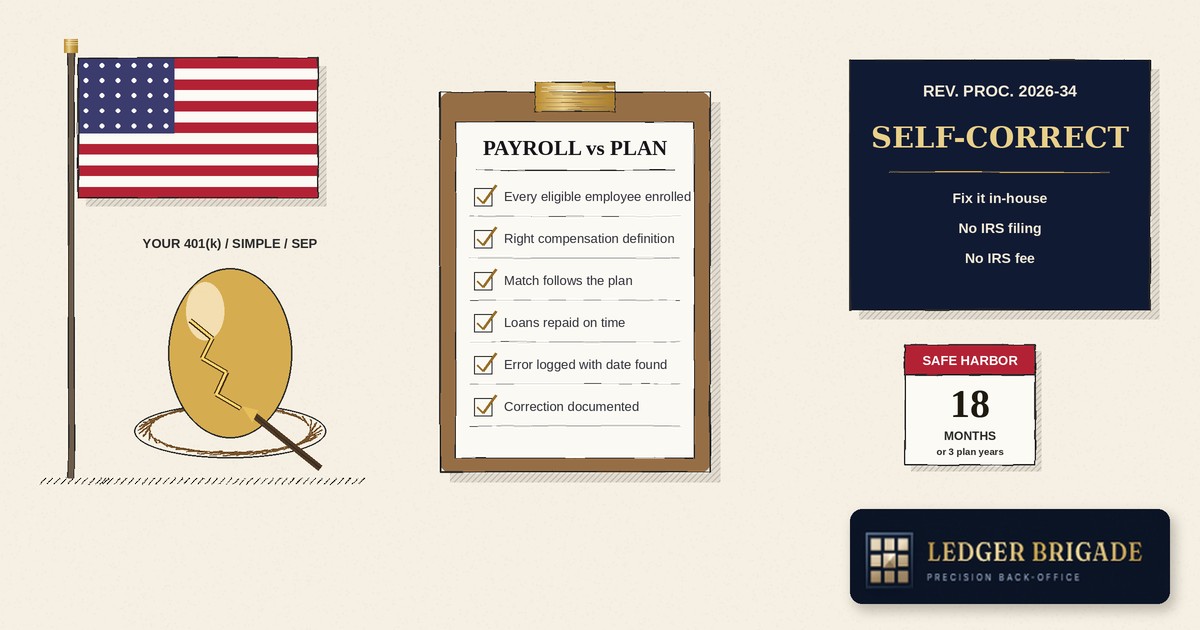
- Compare 2026 payroll to the plan. Check that every eligible employee is enrolled, that deferrals came from all plan-defined compensation (including bonuses, if the plan says so) and that the match follows the plan.
- Check participant loans. Confirm the amounts, terms and repayments by payroll deduction.
- Log any errors with the date you identified them. That date starts the 18-month safe-harbor clock.
- Document every correction, including calculations, notices and deposit dates. SCP has no filing, so your file is your proof.
- SIMPLE IRA and SEP sponsors: review new-hire elections and contribution percentages before the last 2026 payroll.
- Talk to your plan's third-party administrator (TPA) or ERISA counsel before you correct anything that involves a plan amendment or overpayment recovery.
Frequently asked questions
Do I have to file anything with the IRS to self-correct?
No. SCP has no filing and no fee. You must keep documentation showing the error, the correction method and the timing.
Does this apply to my SIMPLE IRA or SEP?
Yes. Rev. Proc. 2026-34 covers qualified plans, 403(b) plans, SEPs and SIMPLE IRA plans. SEP and SIMPLE self-correction depends on meeting the document requirements, and the automatic enrollment safe harbor applies only if the plan has an automatic enrollment or escalation feature.
I fixed an error last year under the old rules. Do I need to redo it?
Generally no. Corrections made under Rev. Proc. 2021-30 at the time it applied should stand. If a correction is still open, ask your TPA whether the new rules offer a cheaper route.
Does this cover late deposits of employee deferrals?
No. Late deposits of payroll deductions are mainly a Department of Labor matter. The DOL's Voluntary Fiduciary Correction Program (VFCP), updated in 2025, includes a self-correction option for delayed participant contributions.
Can my employees use the new IRA program now?
Not yet. ICRS starts on 1 May 2027, and the fee before 2028 is $3,500 for an individual submission. During 2027 and 2028, requests to waive the 60-day rollover deadline will move from the private letter ruling process to ICRS.
Need help?
Ledger Brigade's US team, overseen by qualified US CPAs, helps small businesses reconcile payroll with their retirement plan and keep the year-end file in order. Email hello@ledgerbrigade.com or book a briefing.
When did you last check your payroll against your plan document? Tell us in the comments.
Disclaimer: General information, not tax, legal or ERISA advice. Retirement plan corrections depend on your plan document and facts. Confirm any correction with your plan's TPA, ERISA counsel or a licensed tax professional before acting.
Sources
- IRS, IR-2026-126 (22 October 2026).
- Rev. Proc. 2026-34, sections 2.02, 6.03 and 6.05.
- Rev. Proc. 2026-33 (IRA Compliance Resolution System).
- Internal Revenue Code section 414(cc); IRS Notice 2024-2.
- IRS, Correcting Plan Errors and the SIMPLE IRA Plan Fix-It Guide.
- US Department of Labor, VFCP improvements (January 2025).
Comments (0)
Be the first to comment.
Leave a comment