By Abhinav Chhabra, Ledger Brigade | 25 October 2026
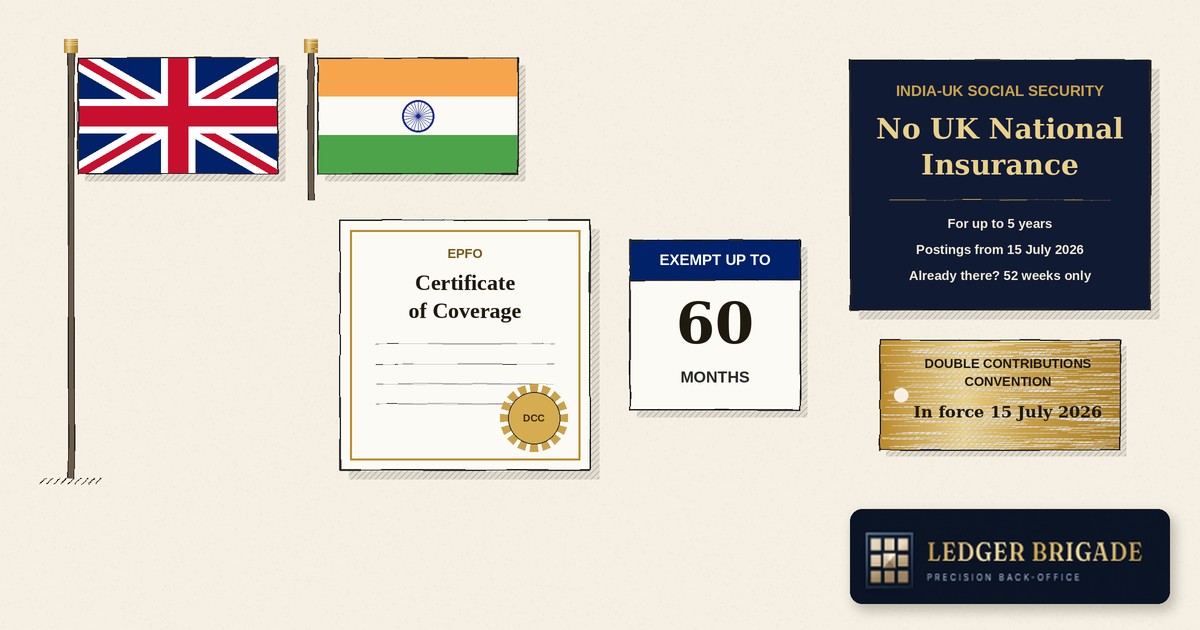
Since 15 July 2026, an Indian professional sent to the UK by their Indian employer can work there for up to five years without paying UK National Insurance, and so can the employer. Before this, the exemption lasted only 52 weeks (under regulation 145(2) of the Social Security (Contributions) Regulations 2001), after which both sides paid into the UK system on top of India's provident fund: a cost of roughly a quarter of salary that bought no benefits for most short-term workers.
The change comes from the India-UK Double Contributions Convention (DCC), which entered into force alongside the India-UK trade agreement. It is a real saving, but it is not automatic, it is not retrospective, and it has a trap that is catching people who were already in the UK. This guide explains who qualifies, what it is worth, and what employers on both sides need to do.
1. What the agreement does
The DCC makes sure that workers moving between the UK and India pay social security contributions in only one country at a time. The general rule is that you pay where you work. The exception, and the valuable part, is for detached workers:
- India to the UK: employees sent to work temporarily in the UK by their Indian employer, on or after 15 July 2026, remain under Indian social security (EPF) if their UK work is not expected to exceed 60 months. Neither the employee nor the employer pays UK National Insurance.
- UK to India: employees sent to work temporarily in India by their UK employer, on or after 15 July 2026, remain under UK National Insurance for up to 60 months, instead of joining Indian social security.
The agreement covers social security contributions only. It does not change income tax: an Indian employee working in the UK may still owe UK income tax under UK rules and the India-UK tax treaty.
2. Who qualifies as a "detached worker"
In broad terms, you qualify if:
- you are employed by an employer that normally operates in India (for the India-to-UK case), and you have been under Indian social security, with employee and employer contributions paid, for at least 30 days before leaving for the UK (or for the calendar month before the posting starts), so someone hired in India just to be sent to the UK will not qualify straight away;
- your employer sends you to work in the UK on its behalf;
- your work in the UK is expected to last no more than 60 months; and
- your posting starts on or after 15 July 2026.
You can also qualify if you choose to work temporarily in the UK (for example, to be near family) and your Indian employer agrees (Article 8(4)(b)).
You do not qualify if a UK employer hires you locally: you are then in the UK system from day one and pay National Insurance like any UK employee.
One cost to plan for: while you are covered by Indian social security, you and your employer pay Indian contributions on your total wages (Article 8(7), using the definition of wages in India's Code on Social Security, 2020), so budget for the Indian side when estimating the saving.
3. The trap: already in the UK before 15 July 2026?
This is where many workers and employers are getting it wrong. The five-year exemption applies only to postings that start on or after 15 July 2026. If you were sent to the UK by your Indian employer and were already working there immediately before 15 July 2026, you are not a detached worker under the DCC for that posting.
HMRC's position on these workers changed during the year:
- its July 2026 guidance said they became liable to UK National Insurance from 15 July 2026;
- on 7 October 2026, HMRC published further guidance describing a transitional mechanism agreed with EPFO (under the agreement's Article 12 exceptions): workers already on assignment keep their pre-agreement position, meaning the old 52-week exemption, until it runs out. For Indian employees already in the UK this applies automatically, with no certificate needed: they start paying UK National Insurance from the contribution week after their 52-week exemption ends. (UK employees already working in India can request a UK certificate of coverage under Article 12 to keep paying UK National Insurance instead.)
Either way, the result is the same in one important respect: they do not get five years. At most they keep the remainder of their 52 weeks. If your payroll stopped National Insurance on the strength of the "five years" headlines, check it now: once the 52 weeks are up, National Insurance is due, and arrears and interest build up quietly.
The agreement also stops postings being ended and restarted to reset the clock (Article 8(5)): once a detached posting ends, a new one cannot begin until six months have passed, or, if the previous posting was shorter than six months, until a period as long as that posting has passed (a four-month posting means a four-month wait).
4. What it is worth
Illustrative figures for the 2026-27 UK tax year, using the current National Insurance rates (employee 8% between £12,570 and £50,270 and 2% above; employer 15% above £5,000).
An Indian IT consultant is seconded to London on a salary of £60,000 a year.
| Each year | Over a five-year posting | |
|---|---|---|
| Employee National Insurance avoided | £3,211 | about £16,050 |
| Employer National Insurance avoided | £8,250 | about £41,250 |
| Total | £11,461 | about £57,300 |
Under the old rules, only the first 52 weeks were exempt. Under the DCC, the whole posting can be, provided the Certificate of Coverage is in place. (UK rates and thresholds can change from year to year; the figures above assume today's rates throughout.)
5. How to claim it: the Certificate of Coverage
The exemption is not automatic. The evidence is a Certificate of Coverage:
For Indian employees going to the UK
- Before the posting starts, the Indian employer applies to the Employees' Provident Fund Organisation (EPFO) for a Certificate of Coverage, using the employee's UAN.
- EPFO issues the certificate, confirming that Indian social security continues to apply.
- The employee and employer keep EPF contributions going in India.
- The certificate is shared with whoever runs the UK payroll (or the UK host employer), so that no UK National Insurance is deducted.
- If the posting changes (it is extended, the role changes, or the employee joins a UK employer), check whether the conditions still hold.
For UK employees coming to India
- The UK employer or employee applies to HMRC for a certificate using Form CA9107.
- The employee keeps paying UK National Insurance through UK payroll.
- The certificate is shown in India as evidence that Indian social security contributions are not due during the posting. This matters: without it, a foreign national working in India is generally treated as an "international worker" under India's EPF scheme and must contribute on their full salary.
6. Voluntary UK National Insurance: a point to check
Some Indians who have worked in the UK pay voluntary UK National Insurance to build up a UK State Pension. From 15 July 2026, if you are within the scope of the DCC and liable to Indian social security contributions, you cannot pay voluntary UK National Insurance for the same period. HMRC asks anyone affected to stop payments and tell HMRC. People living but not working in India, or self-employed in India, may still be able to pay voluntary contributions.
7. Checklist for employers
Indian employers sending staff to the UK
- List everyone currently in the UK and when their posting started: anyone there before 15 July 2026 does not get the five-year exemption, and keeps only the remainder of their original 52-week exemption before UK National Insurance applies.
- For new postings, apply for the EPFO Certificate of Coverage before departure.
- Make sure the assignment letter shows a temporary posting of no more than 60 months, on your behalf.
- Keep EPF contributions running in India and keep the certificate on file.
- Review income tax separately: the DCC does not cover it.
UK employers sending staff to India
- Apply for the HMRC certificate (Form CA9107) before the posting.
- Keep UK payroll and National Insurance running for the posting.
- Plan for Indian income tax and any Indian payroll obligations separately.
Frequently asked questions
I have been in the UK since March 2026 on a posting from my Indian employer. Am I exempt for five years?
No. Employees already in the UK immediately before 15 July 2026 are not detached workers under the DCC. Under HMRC's transitional guidance of October 2026, you may be able to keep the remainder of your original 52-week exemption, after which UK National Insurance applies.
Does the DCC mean I pay no UK tax at all?
No. It covers social security contributions only. UK income tax depends on UK tax rules and the India-UK tax treaty.
I was hired directly by a UK company. Does the agreement help me?
No. Locally hired employees pay National Insurance in the UK in the normal way.
What happens if my posting runs beyond 60 months?
The detached-worker exemption is designed for postings expected to last no more than 60 months. Beyond that, the general rule (pay where you work) applies, unless the UK and Indian authorities agree an exception under Article 12 of the agreement, which has to be requested. Plan any extension early.
Is the exemption automatic?
No. You need a Certificate of Coverage: from EPFO for Indian employees going to the UK, and from HMRC (Form CA9107) for UK employees coming to India.
How Ledger Brigade can help
Ledger Brigade handles payroll and compliance on both sides of this corridor: Indian payroll compliance including PF, ESI, professional tax and TDS, and UK payroll and tax compliance through our UK services. We can help you review existing postings, set up certificates of coverage for new ones, and keep payroll right in both countries. Email hello@ledgerbrigade.com or book a briefing.
Is your company already using the five-year exemption? Tell us in the comments.
Important information. This article is general information about the India-UK Double Contributions Convention, stated as at 25 October 2026. It is not tax, legal or employment advice. The figures are illustrative, UK National Insurance rates and thresholds can change, and each posting depends on its own facts. Confirm your position with a qualified adviser, EPFO or HMRC before relying on the exemption.
Sources
- HM Revenue and Customs, "UK and India: new social security agreement" (published 7 July 2026, updated 30 September 2026), gov.uk.
- UK-India Double Contributions Convention (Agreement on social security relating to social security contributions), signed 10 February 2026, in force 15 July 2026.
- Exchange of Letters regarding the negotiation of a Double Contributions Convention, UK Treaty Series No. 52 (2025), 24 July 2025.
- HMRC National Insurance Manual, NIM33250 to NIM33263 (Special Cases: India), including NIM33252 (transitional situations), NIM33258 (detached workers, updated 7 October 2026) and NIM33262 (exceptions under Article 12); summarised in KPMG GMS Flash Alert 2026-259 and ICAEW Tax news in brief, 14 October 2026.
- Social Security (Contributions) Regulations 2001, regulation 145(2).
- HMRC Form CA9107 (certificate of coverage for workers paying UK National Insurance in a country with a social security agreement); HMRC CWG2, Further guide to PAYE and National Insurance contributions.
Comments (0)
Be the first to comment.
Leave a comment