By Abhinav Chhabra, Ledger Brigade | 25 October 2026
A low CIBIL score costs real money. It can mean a rejected home loan, a higher interest rate on a car loan, or a credit card limit too small to be useful. The good news: a credit score is not a verdict. It is a running record, and since 1 July 2026 lenders update it four times a month, so the right steps start showing within weeks, not years.
This guide covers both halves of the problem: how to get wrong entries removed (a loan you closed that still shows as active, a loan that is not yours, a payment marked late that was on time), and how to rebuild a genuinely weak score, step by step.
1. First, know what you are fixing
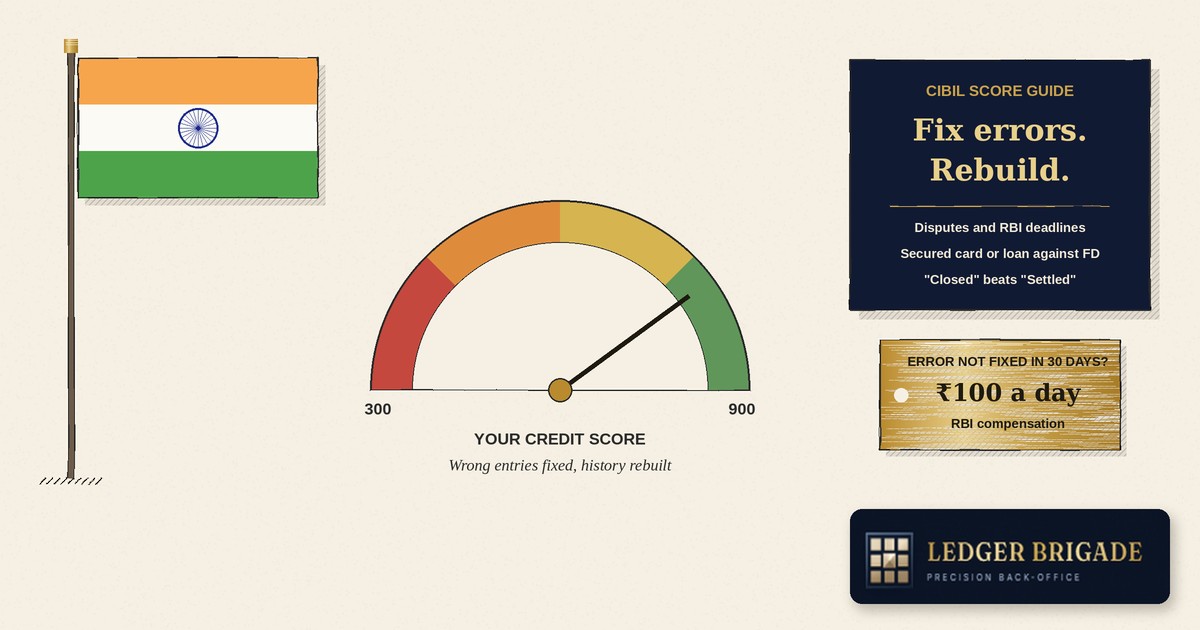
Your CIBIL score (from TransUnion CIBIL) runs from 300 to 900. Most banks treat 750 and above as good. India has four credit bureaus, and lenders may check any of them:
- TransUnion CIBIL
- Experian
- Equifax
- CRIF High Mark
The same loan should appear with all four, but errors are often bureau-specific, so check all of them.
Start with the full reports, not just the score. Under an RBI requirement in force since 2017, every bureau must give you one full credit report a year at no cost. Space them out (for example CIBIL in January, Experian in April, Equifax in July, CRIF High Mark in October) and you can watch your credit all year without paying anything. Checking your own report is a "soft" enquiry: it does not reduce your score.
What actually moves the score
| Factor | What it means | What helps |
|---|---|---|
| Payment history | Whether every EMI and card bill was paid on time; "days past due" (DPD) on each account | Zero DPD, month after month |
| Credit utilisation | How much of your card limits you use | Keep it under 30% of the limit, lower is better |
| Credit mix | Secured loans (home, car, gold, loan against FD) and unsecured credit (cards, personal loans) | A healthy mix, managed well |
| Length of history | How old your accounts are | Keep your oldest card open |
| New credit enquiries | Each loan or card application creates a "hard" enquiry | Space applications out; apply only where you are likely to qualify |
2. Read your report like a lender
Open the report and go account by account. Look for:
- Accounts you do not recognise: a loan or card you never took (identity misuse, or someone with a similar name and PAN mismatch);
- Closed loans still showing as active, or with an outstanding balance;
- Late payments that were not late: DPD shown in months you paid on time;
- "Settled" or "Written-off" status: these are serious negatives (more on them below);
- Loans where you are a co-borrower or guarantor: their defaults hit your score too;
- Wrong personal details: name, date of birth, PAN, address or phone number;
- Duplicate entries for the same loan.
Make a list: account, lender, what is wrong, and what proof you have.
3. How to remove wrong entries: the dispute process
Inaccurate data can be corrected; accurate data cannot. No one, including paid "credit repair" agents, can legally remove a genuine late payment or default. But errors must be fixed, and the RBI has put firm deadlines on lenders and bureaus.
Step by step
- Collect your proof. For a closed loan: the No Objection Certificate (NOC) or closure letter and the final statement. For a payment marked late: the bank statement showing the payment date. For an account that is not yours: anything showing you never applied.
- Raise the dispute with the bureau. On CIBIL, log in to your myCIBIL account and use the dispute section; the other bureaus have similar online forms. Mention the specific account and the specific error, and upload your proof. You can also complain directly to the lender (the "credit institution").
- Note the reference number and the date. The clock starts on the day you file.
- The bureau sends your dispute to the lender, who checks its records and sends corrected data back to the bureau.
- Check all four bureaus after the correction: a fix with one bureau does not always flow to the others. Raise the same dispute with each bureau that shows the error.
The deadlines, and what you get if they are missed
Under the RBI's framework for compensation for delayed updation or rectification of credit information (in force since April 2024):
- the lender must send corrected data to the bureau within 21 calendar days of being told about the error;
- the bureau then has the rest of the 30-day window to update your report;
- if your complaint is not resolved within 30 calendar days of filing, you are entitled to ₹100 for every day of delay, paid by the lender or the bureau responsible (or shared between them), credited to your bank account within 5 working days of resolution;
- the lender or bureau must tell you what action it took, including the reasons if it rejects your complaint.
If it is not resolved: escalate to the grievance redressal (nodal) officer of the lender or the bureau, then to the RBI Ombudsman under the Reserve Bank Integrated Ombudsman Scheme, through the RBI's Complaint Management System (cms.rbi.org.in). Since September 2022, the Scheme covers credit bureaus as well as lenders, so you can complain against either.
A loan you never took? Treat it as possible fraud: dispute it with every bureau, inform the lender in writing, and report it on the national cybercrime portal (cybercrime.gov.in, helpline 1930) and to the police. Keep copies of everything.
Prefer expert help? Credit report correction service: ₹999. If your report has an entry that is genuinely wrong, Ledger Brigade does the groundwork for you. You share your credit reports and supporting documents with us (never your passwords), and we:
- review your reports from all four bureaus and identify every inaccurate entry;
- prepare each dispute: the exact wording, the documents to attach, and the letters to the lenders concerned;
- guide you through submitting each dispute from your own bureau account, which takes a few minutes;
- track the 30-day deadline and send one follow-up on each dispute if it is not resolved in time.
Escalations are separate work and are quoted separately: if a dispute needs to go to a grievance redressal officer or to the RBI Ombudsman, or a claim for the ₹100-a-day compensation, we will tell you the fee before starting.
Please note: we correct inaccurate information only. We cannot remove accurate entries such as genuine late payments or defaults, and we do not guarantee any improvement in your score; the outcome of each dispute rests with the lender and the bureau. Any RBI compensation for delays is paid to you, not to us. Book the service or email hello@ledgerbrigade.com.
4. Clear defaults the right way: "closed" beats "settled"
If you have overdue EMIs or a defaulted loan, paying it off is the single most important step. But how you close it matters.
| Status on your report | What it means | How lenders read it |
|---|---|---|
| Closed | You repaid in full | Good |
| Settled | The lender accepted less than the full amount and wrote off the rest | A serious negative that stays on your history |
| Written-off | The lender gave up recovering the loan | One of the worst entries possible |
What to do:
- Overdue but still active: pay the overdue amount immediately to bring the account back to zero DPD. Every month you stay overdue adds another negative entry.
- Already "settled": you can usually go back to the lender, pay the amount that was waived (sometimes with interest), and ask them to update the status to "Closed". Get the revised status and an NOC in writing, then check that all four bureaus show "Closed".
- About to settle: before accepting a one-time settlement offer, ask whether you can pay in full instead, even over a few months. A settlement saves money now but costs more in future interest rates.
- Card dues: clear the full outstanding, not just the minimum due.
Paying a default does not erase the past late payments, but the account stops getting worse, and new on-time payments start to outweigh the old entries.
5. Rebuild your score: a practical plan
Once errors are fixed and defaults are cleared, you need fresh, positive history. If your file is thin or damaged, the safest way is secured credit: credit backed by something you own, so lenders approve it easily and it costs you little.
Option 1: a secured credit card against a fixed deposit
Open a fixed deposit (even a modest one) and take a credit card linked to it; the limit is usually a large share of the FD amount. Then:
- use it for one or two small regular expenses (a phone bill, fuel);
- keep the balance under 30% of the limit;
- pay the full statement amount before the due date, every month (set up auto-debit).
Your FD keeps earning interest, and you build a clean record of on-time payments.
Option 2: a small secured loan, repaid on time
A loan against your fixed deposit or a small gold loan is easy to get and builds history fast. Borrow a small amount you can comfortably repay, choose a short tenure (6 to 12 months), and never miss an EMI.
Make sure the lender reports to the credit bureaus. Banks and NBFCs regulated by the RBI must be members of all four bureaus and report to each of them, but a loan from a friend, a chit fund or an informal lender will not help your score at all.
Habits that keep the score climbing
- Automate every payment. Set auto-debit for all EMIs and card bills; one missed EMI can undo months of progress.
- Watch the statement date, not just the due date. Your card balance on the statement date is what gets reported, so paying down before it lowers your reported utilisation.
- Apply for credit sparingly. Several loan or card applications in a short period suggest credit hunger. Space them out and use lenders' eligibility checks first.
- Keep old cards open, especially your oldest one, unless it charges a fee you cannot justify; it lengthens your history and adds to your total limit.
- Be careful about guaranteeing or co-signing loans. If the borrower defaults, it is your score that drops.
- Check your report every few months, and act on any error immediately.
- Keep your mobile number and email up to date with every lender. Under the RBI's October 2023 customer service rules, you should get an SMS or email when a bureau's report on you is accessed and when a lender reports a default, which is often the fastest way to spot an error or a loan taken in your name.
A realistic timeline
| When | What to do | What to expect |
|---|---|---|
| Week 1 | Download all four reports; list errors and defaults | A clear picture of the problem |
| Weeks 1 to 2 | File disputes with proof; pay all overdues | Disputes must be resolved within 30 days |
| Month 1 | Open a secured card or small secured loan; set up auto-debit | First on-time payments start being reported |
| Months 1 to 3 | Keep utilisation low; convert any "settled" account to "closed" | Corrections show up; the score starts to move |
| Months 6 to 12 | Keep every payment on time; avoid new applications | Steady improvement, often into the range banks prefer for major loans |
Results vary with your history: a single error fixed can lift a score quickly, while recovering from a serious default takes consistent months of clean repayment.
6. Why your score now moves faster
Until 2024, lenders sent data to the bureaus once a month. From 1 January 2025, the RBI required fortnightly reporting. Since 1 July 2026, under the RBI's Credit Information Reporting (Amendment) Directions of December 2025, lenders report on four dates a month: the 9th, 16th and 23rd (changes since the last date) and the last day of the month (a full file, due by the 5th of the next month).
That cuts both ways: a cleared overdue or a closed loan reaches your report within days, but so does a missed EMI.
Common myths
- "Checking my score lowers it." No. Your own check is a soft enquiry. Only lenders' checks when you apply for credit count.
- "A credit repair company can delete my defaults." No one can remove accurate information. Paid help can only take on the work of disputing genuine errors, which you can also do yourself; be wary of anyone who promises to "clean" your report or guarantees a score.
- "Settling a loan cleans my record." No. "Settled" is itself a negative status. Paying in full ("Closed") is what lenders want to see.
- "Closing all my cards will help." Usually not: it shortens your history and raises your utilisation on the cards you keep.
- "My income affects my score." No. Income is not part of the score, although lenders check it separately.
Frequently asked questions
How long does it take to fix an error on my CIBIL report?
The lender and the bureau together have 30 days from the date you file. After that, you are entitled to ₹100 for each day of delay.
Can I get a "settled" status changed?
Often yes: pay the waived amount, ask the lender to report the account as "Closed", and get it in writing. The lender decides, so ask before you pay.
Will a small loan against FD really help?
Yes, if the lender reports it to the bureaus and you repay every EMI on time. It adds a secured account and a fresh run of on-time payments to your history.
Do I need to check all four bureaus?
Yes. Lenders use different bureaus, and an error fixed with one is not always fixed with the others.
Someone took a loan in my name. What now?
Dispute it with every bureau, write to the lender, and report it on cybercrime.gov.in (or call 1930) and to the police.
Planning a home or business loan?
Lenders look at more than your score: they ask for income tax returns, and for businesses, GST returns and financial statements. Ledger Brigade's team, with work reviewed by qualified CAs, files income tax returns, keeps books and handles GST compliance, so your paperwork is ready when the bank asks. And if your credit report has a wrong entry, our credit report correction service (₹999) will prepare the disputes and guide you through them. Email hello@ledgerbrigade.com or book a briefing.
What has helped your credit score the most? Tell us in the comments.
Important information. This article is general information about credit reports and scores in India, stated as at 25 October 2026. It is not financial, legal or credit advice, and Ledger Brigade is not a credit information company. Our credit report correction service prepares disputes about genuine inaccuracies and guides you through filing them from your own account; escalations are charged separately. It does not remove accurate information, does not guarantee any change in your score, and the outcome of each dispute rests with the lender and the credit bureau. Credit scoring methods belong to each bureau and can change, and individual results vary. Check the current rules with the bureau or your lender before acting, and do not pay anyone who promises to remove accurate information from your credit report.
Sources
- Reserve Bank of India, Framework for compensation to customers for delayed updation/rectification of credit information (circular of 26 October 2023, effective April 2024), under section 11 of the Credit Information Companies (Regulation) Act, 2005, section 21(3) of the Act and rule 20(3)(c) of the Credit Information Companies Rules, 2006.
- Reserve Bank of India, circular on frequency of reporting of credit information (8 August 2024; fortnightly reporting from 1 January 2025).
- Reserve Bank of India, Credit Information Reporting (Amendment) Directions, 2025, dated 4 December 2025 (reporting on the 9th, 16th, 23rd and last day of the month from 1 July 2026).
- TransUnion CIBIL, framework for compensation and dispute resolution pages.
- Reserve Bank of India, Strengthening of customer service rendered by Credit Information Companies and Credit Institutions (circular of 26 October 2023: alerts and customer rights).
- Reserve Bank of India, Free full credit report to individuals (circular of September 2016, effective 1 January 2017).
- Reserve Bank Integrated Ombudsman Scheme, 2021 (credit information companies included from 1 September 2022).
Comments (0)
Be the first to comment.
Leave a comment