By Abhinav Chhabra, Ledger Brigade | 21 October 2026
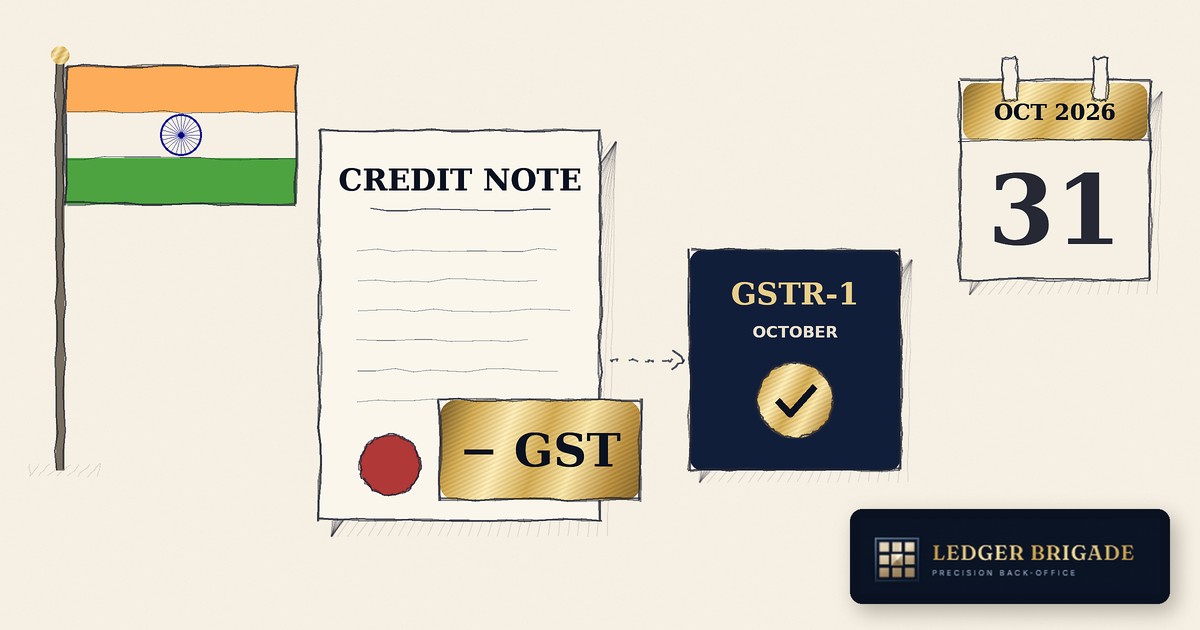
If a customer returned goods, you corrected an over-charged invoice, or you gave a discount on a supply made between April 2025 and March 2026, you probably need to issue a GST credit note. The law gives you until 30 November 2026. In practice, most businesses have until 31 October 2026, which is only days away.
Here's why, and what changed in the rules from 1 October 2025.
What the law says
Section 34(2) of the CGST Act says a registered person who issues a credit note must declare it in the return for the month in which the credit note is issued, and no later than the earlier of:
- 30 November following the end of the financial year in which the original supply was made, or
- the date the annual return (GSTR-9) for that year is filed.
For supplies made in FY 2025-26, the outer limit is therefore 30 November 2026, or earlier if you file your GSTR-9 for FY 2025-26 before then.
The deadline is linked to the financial year of the original supply, not the date of the credit note.
Why 31 October is the real deadline
The credit note must be reported in the return for the month it is issued. That creates a trap:
| Credit note issued in | Reported in | Return due | Within 30 November? |
|---|---|---|---|
| October 2026 | October GSTR-1 | 11 November 2026 | Yes |
| November 2026 | November GSTR-1 | 11 December 2026 | No |
A credit note dated in November has to go into the November return, which is filed in December, after the 30 November limit. So for monthly filers, a credit note against an FY 2025-26 supply should be dated on or before 31 October 2026 and reported in the October GSTR-1.
Quarterly (QRMP) filers: the quarterly GSTR-1 for October to December is due in January, which is too late. Report the credit note through the Invoice Furnishing Facility (IFF) for October, due 13 November 2026.
Filing GSTR-9 early? If you file your FY 2025-26 annual return before 30 November, your deadline moves to the date you file it. Issue and report all credit notes for the year first.
What changed from 1 October 2025
The Finance Act 2025 rewrote the proviso to Section 34(2), with effect from 1 October 2025. A supplier can now reduce its output tax through a credit note only if the registered recipient has reversed the input tax credit linked to that credit note, where the recipient had claimed it. This applies to every credit note, whether for returned goods, a price correction or a discount.
In practice, the recipient accepts the credit note on the Invoice Management System (IMS) and reverses the credit. A credit note issued at the last minute leaves your customer no time to act, and your tax reduction can fail even though the credit note itself was in time.
So the safest approach is to issue credit notes well before the deadline and tell your customer to accept them on the IMS.
Worked example
A Delhi supplier sold goods worth ₹10,00,000 plus 18% GST in February 2026. In October 2026, its customer returns goods worth ₹1,00,000 because they were damaged.
- Credit note dated 28 October 2026: reported in the October GSTR-1 by 11 November. The customer accepts it on the IMS and reverses ₹18,000 of credit. The supplier's output tax falls by ₹18,000.
- Credit note dated 15 November 2026: it belongs in the November GSTR-1, filed in December, after the 30 November limit. The supplier cannot reduce its GST by ₹18,000, even though the goods came back. It can only issue a commercial credit note, which settles the amount but carries no GST adjustment.
This example is simplified. For post-sale discounts (rather than returns), the discount must also meet the conditions in Section 15(3) of the CGST Act.
The numbers at a glance
| Item | FY 2025-26 position |
|---|---|
| Legal provision | Section 34(2), CGST Act |
| Outer time limit | 30 November 2026, or the GSTR-9 filing date if earlier |
| Practical last date (monthly filers) | Credit note dated by 31 October 2026, in the October GSTR-1 (due 11 November) |
| Practical route (QRMP filers) | October IFF, due 13 November 2026 |
| Recipient's role (from 1 October 2025) | Must reverse the related ITC, if claimed, for the supplier's reduction to apply |
| After the deadline | Commercial credit note only; no reduction in GST |
Checklist before 31 October
- List FY 2025-26 sales returns, discounts and price corrections that still need a credit note.
- For discounts (not returns), check they qualify under Section 15(3): agreed before or at the time of supply, and linked to specific invoices.
- Issue the credit notes by 31 October 2026, quoting the original invoice numbers.
- Report them in the October GSTR-1 (monthly) or the October IFF (QRMP).
- Ask your customers to accept them on the IMS and reverse the credit promptly.
- Hold off filing GSTR-9 for FY 2025-26 until every credit note for the year is reported.
- On the buying side, check credit notes you've received, and reverse the matching ITC on the IMS.
Frequently asked questions
Is there a time limit for issuing a credit note? Not for issuing it as such. But to reduce your GST, it must be declared in a return by 30 November following the year of supply, or the GSTR-9 filing date if earlier. In practice, that means dating it by 31 October for monthly filers.
Can I issue a credit note after the deadline? Yes, but only as a commercial or financial credit note. It settles the amount between you and your customer, but you can't reduce your GST liability with it.
What if my customer is unregistered? The ITC reversal condition applies only where the recipient is a registered person. The time limit under Section 34(2) still applies.
Does the same 30 November limit apply to input tax credit? Yes. Under Section 16(4), ITC on invoices and debit notes for FY 2025-26 must be claimed by 30 November 2026, or the GSTR-9 filing date if earlier. It's worth checking both sides of your books together.
Missed a GST deadline? Work out what you owe with our free GST late fee calculator and GST interest calculator.
File your GST returns with Ledger Brigade
We prepare and file GSTR-1 and GSTR-3B for businesses across Delhi NCR and the rest of India, with every slab published upfront: nil returns from ₹299 a month, and up to 10 invoices from ₹499 a month. See our GST return filing service, email hello@ledgerbrigade.com, or book a free briefing.
Have you checked whether any FY 2025-26 credit notes are still pending in your books?
Disclaimer: This article is general information, not tax or legal advice. GST law and portal processes change. Check the current position with a qualified professional before acting.
Sources
- CGST Act 2017, Section 34 (credit and debit notes) and Section 16(4) (time limit for ITC), as amended by the Finance Act 2025
- CBIC: cbic-gst.gov.in
Comments (0)
Be the first to comment.
Leave a comment