By Abhinav Chhabra, Ledger Brigade | 22 October 2026
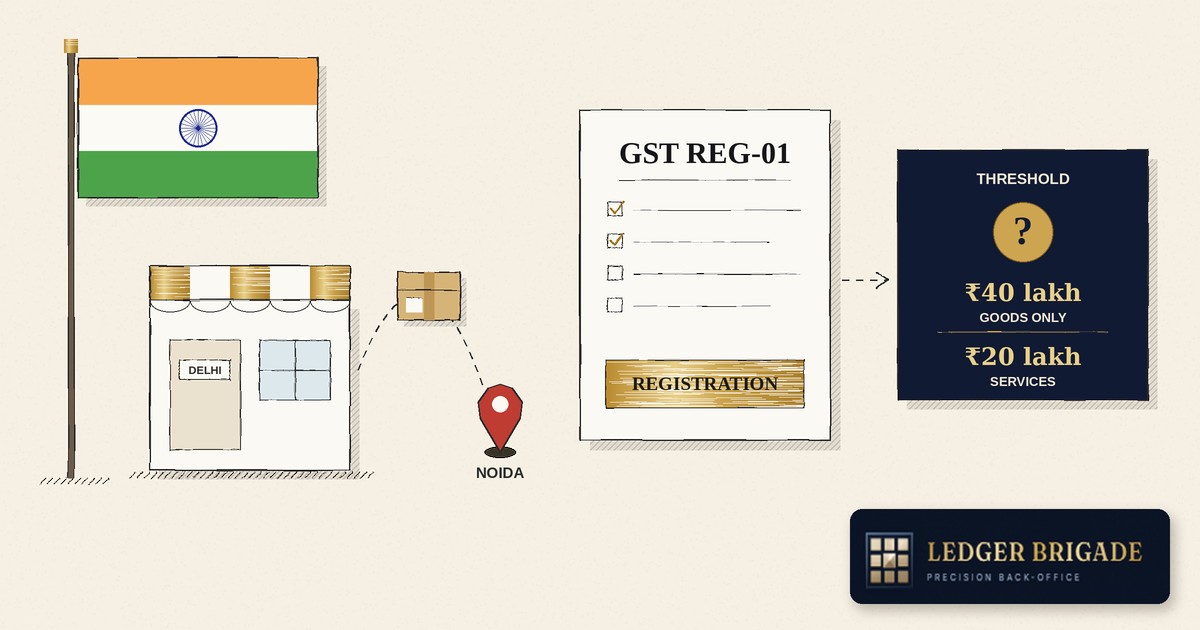
A small shop in Lajpat Nagar sells ₹15 lakh of goods a year, all to customers in Delhi. It does not need GST registration. Then one customer in Noida asks for a parcel. The moment the shop sends it, the law says it needed to be registered.
GST registration is not just about how much you sell. It also depends on what you sell, where it goes and how you sell it. This guide walks through the rules in plain English, with the exact law behind each one.
The basic rule: registration above a turnover threshold
If all your sales stay within your own State, you need to register once your aggregate turnover in a financial year crosses a threshold (section 22(1) of the CGST Act, and Notification No. 10/2019-Central Tax for the higher limit on goods):
| What you supply | Most States (including Delhi, Haryana and Uttar Pradesh) | Arunachal Pradesh, Meghalaya, Puducherry, Sikkim, Telangana, Uttarakhand | Manipur, Mizoram, Nagaland, Tripura |
|---|---|---|---|
| Goods only | ₹40 lakh | ₹20 lakh | ₹10 lakh |
| Services, or goods and services together | ₹20 lakh | ₹20 lakh | ₹10 lakh |
Why three columns? The Act's basic limit is ₹20 lakh, or ₹10 lakh in four "special category States" (Manipur, Mizoram, Nagaland and Tripura). Notification No. 10/2019-Central Tax then raised the limit to ₹40 lakh for businesses that supply only goods, but not for sales within the ten States named in it.
The ₹40 lakh limit has other exceptions too. It does not apply if you sell ice cream, pan masala, tobacco products, bricks, fly ash products or roofing tiles. Those businesses fall back to ₹20 lakh.
What counts towards the threshold
The threshold is tested on aggregate turnover, defined in section 2(6) of the CGST Act. Three things in that definition surprise people:
- Exempt supplies count. If you sell exempt items (fresh vegetables, say) alongside taxable ones, the exempt sales still add up towards the threshold.
- Exports count. A freelancer earning ₹25 lakh from foreign clients has crossed the ₹20 lakh services limit, even though exports carry no GST.
- It is all-India, per PAN. Sales from every branch and every State under the same PAN are added together.
What is left out: the GST itself (CGST, SGST, IGST and cess), and purchases on which you pay tax under reverse charge.
One more thing: section 23 says you never need to register if you supply only exempt or non-taxable goods or services, or if you are an agriculturist selling produce from your own cultivation.
When you must register from the first rupee
Section 24 lists cases where you must register whatever your turnover. The ones that catch small businesses most often:
- Selling goods to another State. Any inter-State taxable supply requires registration (section 24(i)). For goods there is no general turnover relief, so that one parcel from Delhi to Noida is enough.
- Selling through an e-commerce platform that collects tax at source (TCS), such as most large marketplaces (section 24(ix)). There is a narrow relief for small sellers who stay within one State (next section).
- Paying tax under reverse charge. If you receive supplies on which the law makes you, the buyer, pay the GST, you must register (section 24(iii)).
- Selling on behalf of someone else as an agent (section 24(vii)).
- Casual or non-resident taxable persons, such as a trader from another State who sets up a stall at a Delhi exhibition (sections 24(ii) and 24(v)).
The others cover e-commerce operators themselves, input service distributors, persons deducting tax at source under section 51, foreign suppliers of online services to unregistered people in India, and anyone else the government notifies.
Two reliefs worth knowing
1. Services across State lines. Notification No. 10/2017-Integrated Tax exempts persons making inter-State supplies of services from registration while their all-India aggregate turnover stays within ₹20 lakh (₹10 lakh in the four special category States). So a consultant in Gurugram billing clients in Mumbai and Bengaluru can stay unregistered up to ₹20 lakh. Goods get no such general relief.
2. Small e-commerce sellers within one State. Since 1 October 2023, Notification No. 34/2023-Central Tax lets small sellers supply goods through a marketplace without registering, if all of these hold:
- aggregate turnover in the previous and current financial year stays within the limit in section 22(1), generally read as ₹20 lakh in most States (the notification refers to section 22(1), not to the ₹40 lakh goods limit, so the safer reading is ₹20 lakh);
- no inter-State supply of goods at all, and sales through e-commerce in only one State;
- a PAN, declared on the GST portal with your business address and State; and
- an enrolment number from the portal before the first sale through the platform.
In practice, this means telling the marketplace to deliver only within your State. One out-of-State order, and you are back under section 24. Note that this relief covers goods only: services sold through online platforms follow different rules.
Four Delhi NCR examples
Illustrative, not client cases.
| Business | Turnover | Registration needed? | Why |
|---|---|---|---|
| Garment shop in Lajpat Nagar, sells only in Delhi | ₹32 lakh (goods only) | No | Under the ₹40 lakh goods limit, and no inter-State sales |
| The same shop ships one order to Noida | ₹32 lakh | Yes | Delhi to Uttar Pradesh is an inter-State supply of goods (section 24(i)) |
| Graphic designer in Ghaziabad, clients across India and the US | ₹18 lakh, including ₹6 lakh of exports | No | Services under ₹20 lakh, and Notification 10/2017-Integrated Tax covers the inter-State work. Exports count, but the total is still under ₹20 lakh |
| Home-décor seller in Faridabad on a large marketplace | ₹8 lakh | No, if she sells only within Haryana with an enrolment number; otherwise yes | Notification 34/2023-Central Tax relief; a sale to Delhi would end it |
If the designer's income grows to ₹22 lakh, registration becomes compulsory, and because exports are involved, a Letter of Undertaking (LUT) is needed each year to bill foreign clients without GST.
Once you need it: registering
Apply within 30 days of becoming liable, in every State from which you make taxable supplies (section 25(1)).
You can also register voluntarily below the threshold (section 25(3)). Businesses often do this when their buyers are GST-registered and want to claim input tax credit, or when they plan to sell across State lines soon. Once registered, you must file returns, even if they are nil returns.
A faster route for small businesses. Since 1 November 2025, Rule 14A of the CGST Rules offers an optional simplified registration for businesses whose output tax on supplies to registered buyers will not exceed ₹2.5 lakh a month (CGST, SGST, IGST and cess together). With Aadhaar authentication, registration is granted electronically within three working days of the application number. Only one such registration is allowed per PAN in a State.
Documents. You will need proof of your principal place of business. If the premises belong to a family member, the owner gives a consent letter on plain paper with a copy of their identity proof and one ownership document. Our free GST consent letter generator prepares that letter in English or Hindi and tells you exactly what to upload.
Frequently asked questions
I sell from my own website, not a marketplace. Do I need to register?
If you ship goods to customers in other States, yes, from the first sale (section 24(i)). If every customer is in your own State, the normal turnover threshold applies.
I am under the threshold, but a client wants my GSTIN. What can I do?
You can register voluntarily (section 25(3)). Weigh it first: once registered, you charge GST and file returns every month or quarter, even nil returns.
I crossed the threshold in the middle of the year. What now?
You become liable when your aggregate turnover for the financial year exceeds the limit, and you must apply within 30 days.
Do my export earnings count if exports carry no GST?
Yes. Exports are part of aggregate turnover under section 2(6), so they count towards the threshold.
Need help?
Our team prepares and files GST registrations, from ₹1,500 for a sole proprietorship, with fees published on our GST page. Email hello@ledgerbrigade.com or book a briefing.
For the constitutional story behind GST (why the Centre and the States share it, and why neither outranks the other), read Chapter 1 of our GST Guide, Whose Tax Is It Anyway?
Which of these rules surprised you most? Tell us in the comments.
Disclaimer: General information, not tax or legal advice. Law stated as at 22 October 2026. Thresholds and notifications change; confirm your position before acting.
Sources
- Central Goods and Services Tax Act, 2017, sections 2(6), 22, 23, 24 and 25 (CBIC consolidated text).
- Notification No. 10/2019-Central Tax, as amended by No. 03/2022-Central Tax and No. 15/2022-Central Tax: ₹40 lakh limit for goods and its exclusions.
- Notification No. 10/2017-Integrated Tax, 13 October 2017: inter-State supplies of services.
- Notification No. 34/2023-Central Tax: small sellers through e-commerce operators.
- Rule 14A, CGST Rules (Notification No. 18/2025-Central Tax) and the GSTN advisory on the Simplified GST Registration Scheme, reproduced in the GST Council newsletter, November 2025.
Comments (0)
Be the first to comment.
Leave a comment