By Abhinav Chhabra, Ledger Brigade | 23 October 2026
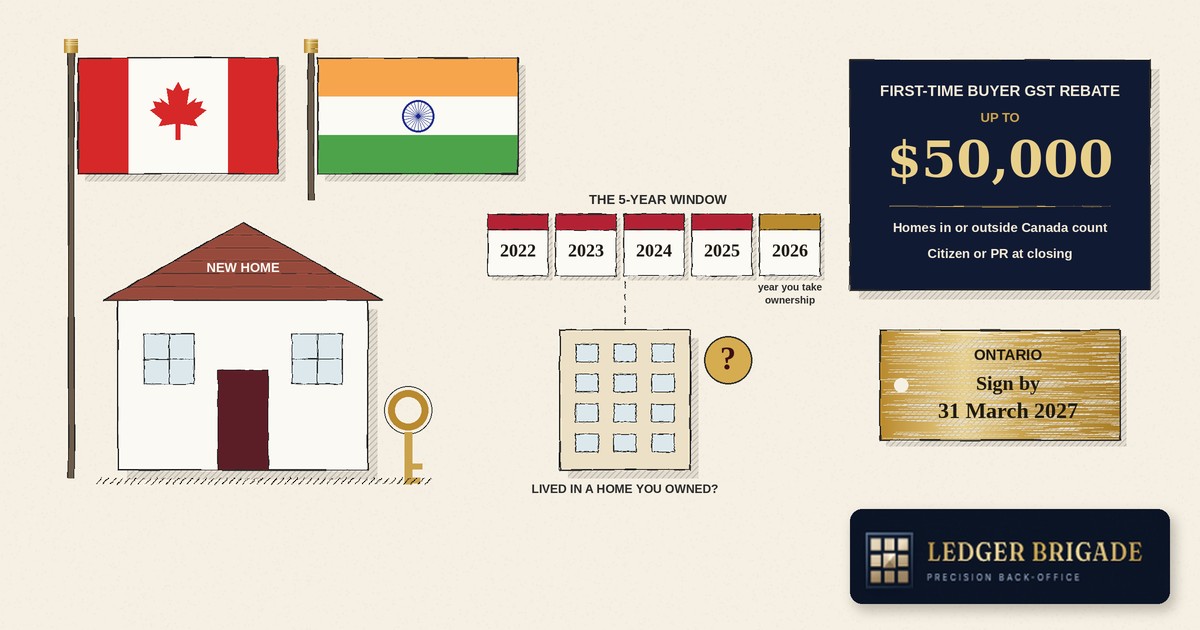
Canada now refunds up to $50,000 of GST on a new home for first-time buyers. For many Indian families buying their first home in Canada, that sounds like it was written for them. But the definition of "first-time" looks back five calendar years and reaches outside Canada. A flat in Pune, a family home in Delhi you jointly own, or the apartment you lived in before you moved: any of these can cost you the rebate, and if your builder credited it at closing, the CRA can recover it from you.
The good news is that the rule is narrower than many people fear, and in Ontario there is a second route that does not care whether you are a first-time buyer at all, if you sign by 31 March 2027.
At a glance
| Federal first-time home buyers' (FTHB) GST/HST rebate | Ontario enhanced new housing rebate (ENHR) | |
|---|---|---|
| What it refunds | The 5% GST, or the federal part of the HST | The 8% provincial part of the HST |
| Maximum | $50,000 | $80,000 (plus up to $50,000 more through the Ontario new home affordability payment) |
| Home value limit | Full up to $1 million; reduced up to $1.5 million | Full up to $1 million; flat $80,000 up to $1.5 million; reduced below $1.85 million |
| Agreement signed | On or after 20 March 2025 and before 2031 | 1 April 2026 to 31 March 2027 |
| Must you be a first-time buyer? | Yes, including homes outside Canada | No |
| Must you be a citizen or permanent resident? | Yes, when ownership transfers | Not listed as a condition in the CRA's notice |
| Where | Every province and territory | Ontario only |
1. What the federal rebate gives you
The first-time home buyers' (FTHB) GST/HST rebate became law when Bill C-4 received Royal Assent on 12 March 2026. It sits on top of the older GST/HST new housing rebate, and together they refund 100% of the GST (or the federal part of the HST) on a new home valued up to $1 million, to a maximum of $50,000. Between $1 million and $1.5 million the rebate shrinks in a straight line; at $1.5 million or more there is none.
The main conditions, from the CRA's GST/HST Memorandum 19-3-10:
- The home must be new (or substantially renovated): bought from a builder, built by you, or a new co-op share. Resale homes are generally exempt from GST anyway, so the rebate is not needed there.
- The agreement of purchase and sale must be signed on or after 20 March 2025 and before 2031. It is the date both sides agreed, not the later date conditions such as financing were waived.
- It must be your primary place of residence, and you must be the first person to live in it after construction.
- It is once in a lifetime, and spouses or common-law partners share that one chance: if your spouse already claimed it, you cannot.
- Only one buyer needs to qualify. The CRA's own example has a first-time buyer whose parents are on title for financing; the child can still claim.
A warning about the builder credit. Most buyers never file anything: the builder credits the rebate against the price at closing and claims it back. But if the buyer was not entitled, and the builder knew or ought to have known, the builder and the buyer are jointly and severally liable to repay it. In practice that means the CRA can assess you, and your builder will want you to sign a declaration that you qualify. Read it carefully, because the test below is not the one most people assume.
2. Who counts as a "first-time home buyer"?
The term is defined in subsection 123(1) of the Excise Tax Act. In the CRA's words, it generally means an individual who, at a particular time:
- is 18 years of age or older
- is a Canadian citizen or permanent resident of Canada within the meaning of subsection 2(1) of the Immigration and Refugee Protection Act
- has not occupied a residential unit as their primary place of residence, situated in or outside of Canada, that the individual owned or jointly owned in the calendar year that includes the particular time or in the four preceding calendar years
- if the individual has a spouse or common-law partner at the particular time, has not occupied a residential unit as their primary place of residence, situated in or outside of Canada, that the individual's spouse or common-law partner owned or jointly owned in the calendar year that includes the particular time or in the four preceding calendar years
Read the third point slowly, because it contains three tests that must all be met before an earlier home counts against you:
- You owned it, alone or jointly. Living in your parents' house does not count against you; being a joint owner of the family home does.
- You occupied it as your primary place of residence, meaning the home you lived in on a permanent basis. Owning a flat that someone else lives in does not count against you.
- It was in the window: the calendar year that includes the "particular time", or any of the four calendar years before it.
The "particular time" is not the day you sign. For a home bought from a builder, it is the day ownership is transferred to you, usually the final closing. For a condo that takes three years to build, the five-year window is measured back from the year it closes, not the year you signed.
Citizenship or permanent residence is tested on that same day. A buyer who signs while on a work permit and becomes a permanent resident before closing can qualify; a buyer who is still on a work permit at closing cannot, unless another buyer on the agreement qualifies.
3. The India question: six situations
In each case below, the new home is bought from a builder and ownership transfers to the buyer in 2026, so the window is 2022 to 2026. (If closing moves to 2027, the window becomes 2023 to 2027. Calendar years run from 1 January to 31 December, so if you last lived in a home you owned until 30 December 2021, that falls outside a 2022 to 2026 window.)
| Your situation | First-time buyer? | Why |
|---|---|---|
| You own a flat in Pune that your parents live in. You have always lived in rented homes or with family. | Yes | You owned it, but never lived in it as your primary place of residence. |
| You lived in your parents' house in Delhi until 2024. It is in your father's name only. | Yes | You lived there, but did not own it. |
| You are a joint owner, with your father, of the family house in Delhi, and lived there until 2024. | No | Jointly owned, lived in as your main home, and 2024 is inside the window. |
| You lived in your own flat in Bengaluru until you moved to Canada in 2023. You still own it and rent it out. | No | 2023 is inside the window. Keeping or selling the flat now does not change that. |
| You lived in your own flat in Hyderabad until 2020, then rented in Canada. | Yes | The last year you lived in a home you owned (2020) is outside the window. |
| You lived with your spouse in a flat your spouse owned in Mumbai until 2023. Your name was never on it. | No | Living in a home your spouse or common-law partner owned counts, even if you never owned it. |
Timing can turn a "no" into a "yes". Take the Bengaluru family: they lived in their own flat until 2023. If ownership of their new condo transfers in 2026, 2027 or 2028, the window still includes 2023, and they do not qualify. If it transfers in 2029, the window is 2025 to 2029, and they do, provided they have not lived in a home they owned since. For buyers of pre-construction homes, the closing year matters as much as the signing date, and a delayed closing can help, not hurt.
The spouse rule works one way. Your spouse's or partner's home counts against you only if you lived in it. If your spouse owned and lived in a flat in Chennai until 2024, before you married, and you never lived there, it does not stop you being a first-time buyer. Your spouse may not qualify, but only one buyer needs to, so you can make the claim (remembering that spouses share one rebate in a lifetime).
Two things that do not matter
- Where the old home was. The test covers homes "situated in or outside of Canada". A flat in India counts exactly like a condo in Toronto.
- Whether you still own it. The test asks whether you lived in a home you owned during the window, not whether you own one today. An Indian flat you own but have never lived in does not stop you, whatever its value.
4. In Ontario, a second route that ignores the first-time test
In Ontario, HST on a new home is 13%: 5% federal and 8% provincial. Three Ontario measures sit alongside the federal rebate:
- The Ontario first-time home buyers' rebate refunds up to 100% of the 8% provincial part (up to $80,000) on new homes up to $1 million, reduced up to $1.5 million. It uses the same first-time test as the federal rebate.
- The Ontario enhanced new housing rebate (ENHR) refunds the 8% provincial part, up to $80,000, on new homes valued under $1.85 million, and it is not limited to first-time buyers. The home must be the primary place of residence of you or a relation (a parent, child, sibling or spouse, for example). The catch is the deadline: the agreement of purchase and sale must be signed between 1 April 2026 and 31 March 2027.
- The Ontario new home affordability payment (ONHAP), paid by the Province of Ontario to people entitled to the ENHR, is worth up to $50,000, equal to up to 100% of the 5% federal part. It is reduced by any federal new housing or FTHB rebate you receive, so if you qualify for the federal FTHB rebate you must claim that first.
Under the ENHR, the rebate is the full 8% up to $1 million, a flat $80,000 from $1 million to $1.5 million, and a reduced amount below $1.85 million. All provincial-part rebates together cannot exceed the lesser of $80,000 and the provincial HST actually paid.
Two rules to watch. An agreement signed before 1 April 2026 that is later varied, altered or assigned is treated as signed before April and does not qualify. And for an assignment sale, both the original agreement and the assignment must fall inside the April 2026 to March 2027 window.
What it is worth: one family, two signing dates
Illustrative figures. The Bengaluru family from the table (not first-time buyers until 2029) buys a new townhouse in Brampton from a builder for $900,000 before HST. HST is $117,000: $45,000 federal part and $72,000 provincial part.
| Signed in December 2026 | Signed in April 2027 | |
|---|---|---|
| Federal FTHB rebate | $0 (not first-time) | $0 (not first-time) |
| Older federal new housing rebate | $0 (price above $450,000) | $0 (price above $450,000) |
| Ontario ENHR (8% provincial part) | $72,000 | $0 (outside the window) |
| ONHAP (5% federal part) | $45,000 | $0 |
| Ontario new housing rebate | Included in the $72,000 above | Up to $24,000 |
| Total HST relief | $117,000 | Up to $24,000 |
Same family, same house, same price: the difference is more than $90,000, and it turns entirely on the date the agreement is signed. The first-time test decides the federal rebate; the calendar decides the Ontario one.
Outside Ontario, the federal FTHB rebate applies in every province, and some provinces have their own new-home measures. Check your province's rules before you sign.
5. Before you sign: a checklist
- Map your last five calendar years, counted back from the year you expect ownership to transfer: every home you, your spouse or your partner owned (alone or jointly), in India or anywhere else, and whether you lived in it as your main home.
- Check your status on the closing date. If you will not yet be a citizen or permanent resident when ownership transfers, the federal rebate depends on another buyer on the agreement.
- In Ontario, check the signing date. An agreement signed by 31 March 2027 may qualify for the ENHR and ONHAP even if you fail the first-time test.
- Keep evidence from India: the sale deed or title documents showing when you bought or sold, and proof of where you actually lived (rental agreements, utility bills, employer letters, passport or visa dates). If the CRA asks, the burden is on you.
- Read the builder's rebate declaration before signing it. If the builder credits a rebate you were not entitled to, the CRA can recover it from you.
- Do not "fix" an old agreement. Terminating a pre-20 March 2025 agreement (or, for the ENHR, a pre-1 April 2026 one) and signing a new one with a related party or the same builder mainly to get the rebate is caught by anti-avoidance rules.
Frequently asked questions
I own a flat in India but have never lived in it. Can I still claim?
Yes, as far as that flat is concerned. The test is about homes you owned and lived in as your primary place of residence during the five-year window.
I sold my flat in India years ago. Does that matter?
Only if you lived in it during the window: the calendar year ownership of the new home transfers to you, or the four years before. If you last lived there earlier than that, it does not count.
I am on a work permit. Can I claim?
Not for the federal rebate, unless you are a citizen or permanent resident by the day ownership transfers, or another buyer on the agreement qualifies. In Ontario, the CRA's notice does not list citizenship or permanent residence as a condition for the ENHR; what it requires is that the home be the primary place of residence of you or a relation.
Does it apply to resale homes?
No. The rebates are for new or substantially renovated homes. Resale homes are generally exempt from GST/HST anyway.
My parents are co-buyers for the mortgage. Do they stop me claiming?
No. Only one buyer needs to be a first-time home buyer, and that person claims. The CRA gives exactly this example.
Need help?
Ledger Brigade helps Indian families and businesses on both sides of the border with Canadian and Indian tax questions, including the records needed from India. Email hello@ledgerbrigade.com or book a briefing.
Did you check the five-year rule before signing, or did your builder raise it? Tell us in the comments.
Disclaimer: General information, not tax or legal advice. Stated as at 23 October 2026. Rebate eligibility depends on your facts and documents; confirm with the CRA or a qualified Canadian tax professional before signing an agreement or a rebate declaration.
Sources
- Canada Revenue Agency, GST/HST Memorandum 19-3-10, First-time Home Buyers' GST/HST Rebate (October 2026)
- Canada Revenue Agency, GST/HST Notice 346, Ontario Enhanced New Housing Rebate (August 2026)
- Excise Tax Act, subsections 123(1) ("first-time home buyer"), 254(2.1), 256(2.1), 263.3 and 263.4; Bill C-4 (Royal Assent 12 March 2026).
- Canada Revenue Agency, GST/HST Policy Statement P-228, Primary Place of Residence
Comments (0)
Be the first to comment.
Leave a comment