By Abhinav Chhabra, Ledger Brigade | 19 October 2026
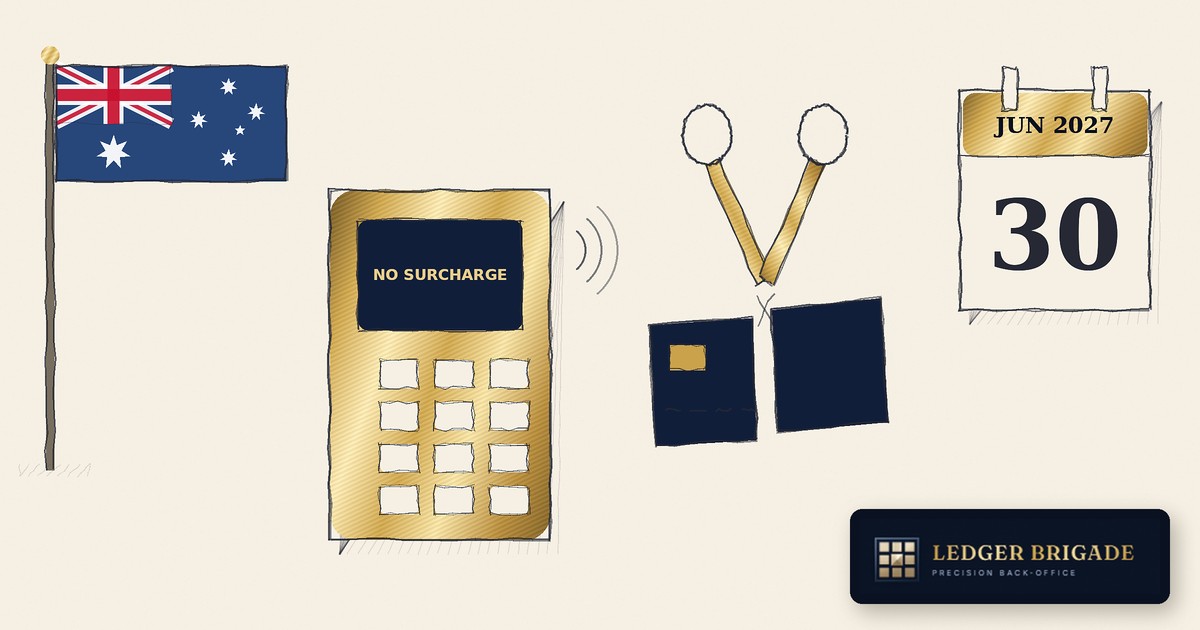
Card payments for Australian small businesses are changing in two ways at once. Since 1 October 2026 you can no longer add a surcharge when customers pay by eftpos, Mastercard or Visa. Credit card payments to the ATO are also ending: after a late change of plan, the last date is now 30 June 2027.
Each change affects your cash flow differently. Here's what has happened, what it means, and what to do before your next BAS.
What changed
1. The surcharge ban (law since 1 October 2026)
After its review of merchant card payment costs, the Reserve Bank removed surcharging on the eftpos, Mastercard and Visa networks. That covers debit, credit and prepaid cards. The RBA is also lowering interchange fee caps for domestic card transactions. Further changes, including a cap on interchange for foreign-issued cards, follow from 1 April 2027.
American Express, buy now pay later services and some mobile wallets fall outside the RBA's ban, and the RBA is reviewing them separately. American Express has said it will remove surcharging on its own cards from the same date. About 16% of Australian businesses were surcharging, according to the RBA.
2. The ATO's credit card cut-off (moved to 30 June 2027)
In response to the RBA reforms, the ATO said it would stop taking credit card payments after 30 November 2026. It said absorbing card fees would cost around $200 million a year. On 9 October 2026, the Treasurer announced transitional funding so the ATO can keep accepting credit cards until 30 June 2027. The cost will be finalised in the Mid-Year Economic and Fiscal Outlook (MYEFO).
After 30 June 2027, the Government says credit card payments will still be possible through third-party providers, and debit cards and bank transfers will remain free or low-fee options. The ATO has warned taxpayers to check that any third-party provider is legitimate before sharing details or paying.
The numbers at a glance
| Item | Detail |
|---|---|
| Surcharge ban start | 1 October 2026 |
| Networks covered | eftpos, Mastercard, Visa (debit, credit, prepaid) |
| Outside the RBA ban | American Express (removing surcharges itself), buy now pay later, some mobile wallets |
| Foreign-card interchange cap | From 1 April 2027 |
| ATO credit card cut-off (original) | After 30 November 2026 |
| ATO credit card cut-off (now) | 30 June 2027 |
| After the cut-off | Credit card only through third-party providers; debit and bank transfer stay |
| ATO direct credit (EFT) | BSB 093 003, account 316385, reference = your PRN only |
| ATO PayID | Not yet available |
| Q1 2026-27 BAS due | 28 October 2026 (25 November via agent e-lodgment) |
What it means for businesses
On the sales side, card fees you used to pass on to customers now come out of your margin. If card payments make up most of your revenue, that adds up quickly. The fix isn't to bring surcharges back under another name. Build the cost into your prices, shop around among payment providers (the reforms require clearer fee disclosure), and make sure your bookkeeping shows the real cost.
On the tax side, the extension gives you breathing room, not a long-term answer. If you use a credit card to smooth out a BAS or income tax payment, plan now for what you'll do from July 2027. Interest charged on unpaid tax (GIC) incurred from 1 July 2025 is no longer tax-deductible, so falling behind costs more than it used to.
Worked examples
These examples are hypothetical and illustrative. Fee rates vary by provider, so check your own merchant statements.
Example 1: a café that used to surcharge. A café takes $60,000 a month in card payments and used to add a 1% surcharge to cover its merchant fees. From 1 October it can't surcharge, so if its blended fee is about 1%, it now absorbs about $600 a month, or $7,200 a year.
To recover that, it could lift menu prices by about 1%, for example 50 cents on a $50 bill. It could also move to a cheaper provider, or both. Either way, the bookkeeper should record gross sales and merchant fees separately, not net deposits, so the true cost shows up in the P&L.
Example 2: a trades business paying its BAS. A plumbing business has a Q1 BAS bill of $14,000 due 28 October and usually pays the ATO by credit card for the cash-flow buffer.
- Until 30 June 2027: it can still pay by credit card through the ATO's card channel. Card fees apply.
- From July 2027: only through a third-party provider (expect fees), or by BPAY, EFT or direct debit from the bank account.
- If cash is tight: a payment plan is an option, but GIC applies and is no longer deductible. A plan linked to a credit card will need a new payment method before the cut-off.
The lesson is to plan for BAS cash, for example by moving GST and PAYG withholding into a separate account each week.
Action checklist
- Remove card surcharges for eftpos, Mastercard and Visa from your point-of-sale, invoicing software and online checkout.
- Check your pricing against your actual merchant fees from the last three months of statements.
- Compare payment providers using the new fee disclosures.
- Fix your bookkeeping: record gross takings and merchant fees separately, and reconcile them each month.
- Review how you pay the ATO. Set up BPAY, EFT or direct debit, and update any payment plan linked to a credit card before 30 June 2027.
- Set up a tax holding account for GST, PAYG withholding and PAYG instalments.
- Diarise 28 October (or 25 November if your agent lodges) for your Q1 BAS.
Frequently asked questions
Can I still surcharge American Express? American Express isn't covered by the RBA ban, but it has said it will remove surcharging on its own cards from the same date. Check your Amex merchant terms before adding any fee. Buy now pay later services sit outside the ban.
Is the ATO credit card ban cancelled? No, it's delayed. The ATO will accept credit cards until 30 June 2027. After that, credit card payments will go only through third-party providers.
What's the cheapest way to pay the ATO? Bank transfer (EFT), BPAY and direct debit are generally free or low-cost. The ATO doesn't have PayID yet.
My payment plan is on a credit card. What do I do? Switch it to a bank account before the cut-off. The ATO says it will write to people who need to change their payment method.
Are merchant fees tax-deductible? Merchant fees are generally a deductible business expense. Record them separately so you claim them correctly.
Talk to us
Want your merchant fees, BAS cash and ATO payments set up properly before the next quarter? Email hello@ledgerbrigade.com or book a free diagnostic call. We'll help you get your books and payment processes current. The call is general guidance only, not preparation or lodgment of a BAS or tax return.
Disclaimer: This article is general information, not tax or legal advice. Payment rules and ATO arrangements may change again before 30 June 2027. Talk to your registered tax or BAS agent about your situation.
Sources
- ATO media release, 9 October 2026: ato.gov.au
- Treasurer's media release, 9 October 2026: treasury.gov.au
- ATO, Changes to credit card payments: ato.gov.au
- ATO, Other payment options: ato.gov.au
- RBA media release 2026-10 (31 March 2026): rba.gov.au
- RBA non-technical summary: rba.gov.au
- ATO fact sheet, Denying deductions for ATO interest: ato.gov.au
- ATO, BAS agent lodgment program 2026-27: ato.gov.au
Comments (0)
Be the first to comment.
Leave a comment